CirrusCare holds the devices someone already wears as one continuous, whole-person view, so their clinician, their pharmacist and the people who love them are all looking after the same person. Most days that means the comfort of knowing all is well.
Heart, glucose, sleep, activity, weight, blood pressure. Read continuously from what is already on their wrist, then held together as one longitudinal, whole-person record that follows the person rather than the appointment.
Resting and daily rhythm, tracked against the patient's own normal, never a population chart.
Continuous readings alongside heart signal, so a drift shows up as a pattern instead of a number.
Nights and movement give the softest early signal that something has changed at home.
Pair one FDA-cleared device and that patient's picture gains a regulated anchor point alongside the rest.
Consumer wearable signal is clinical context. It informs care; it never stands in for a clinical measurement. We hold that line in writing.
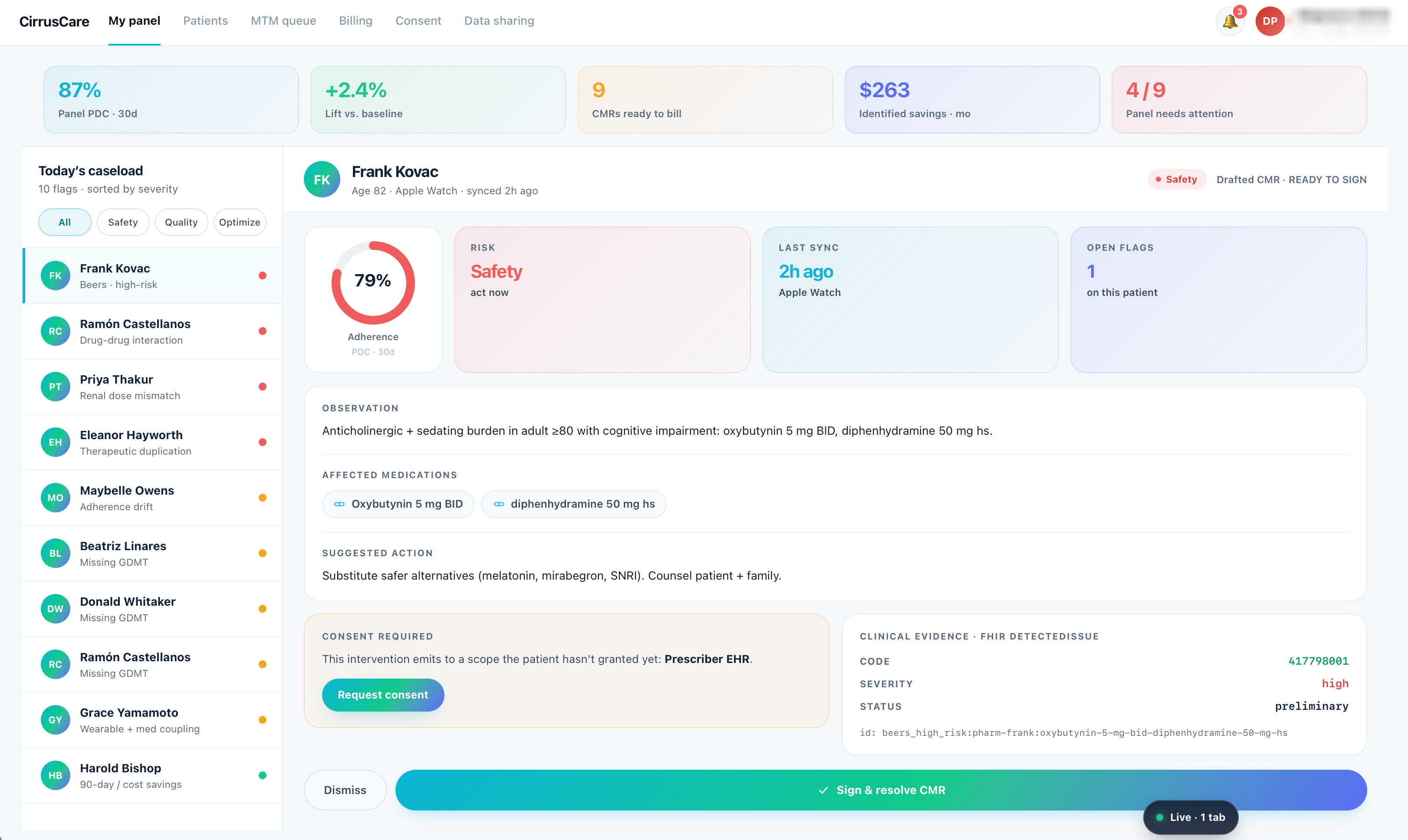
The list at the left is ordered by who drifted from their own normal, not by alphabet or appointment date.
Minutes attach to the person as you work, in the same place your team already documents care.
Consent, care plan and this month's attention on one screen, ordered by who changed.
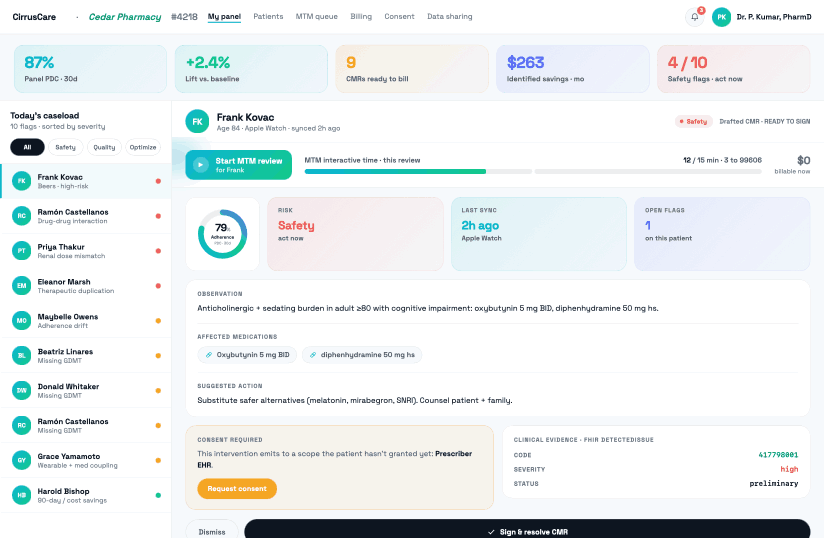
Eligibility and documented consent sit at the top of the record, captured before anyone looks at data.
The weeks after the fill, read as heart and glucose together, so a dose that isn't working shows as a pattern.
A review that opens with what happened at home, not with the refill history.
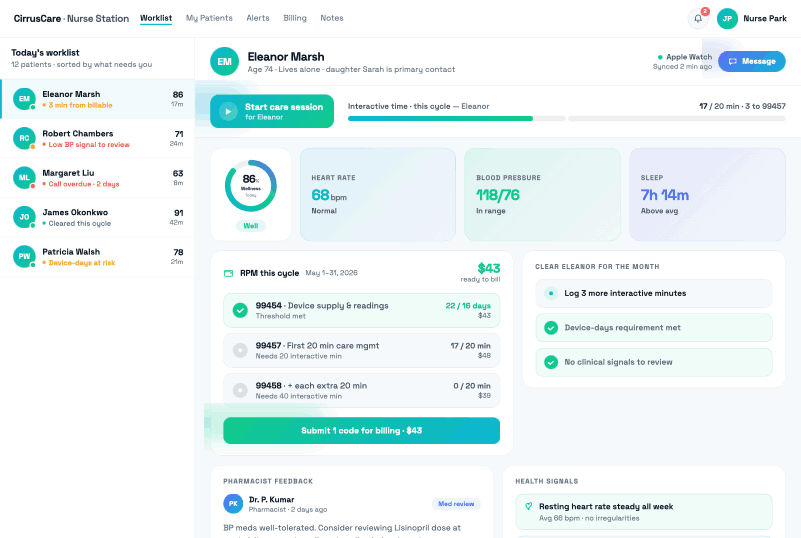
The weeks right after discharge, while a phone call is still enough to change the outcome.
Each finding shows the signals underneath it, so a nurse can look and disagree.
The month where a readmission is still preventable, with the home signal filling the gap.
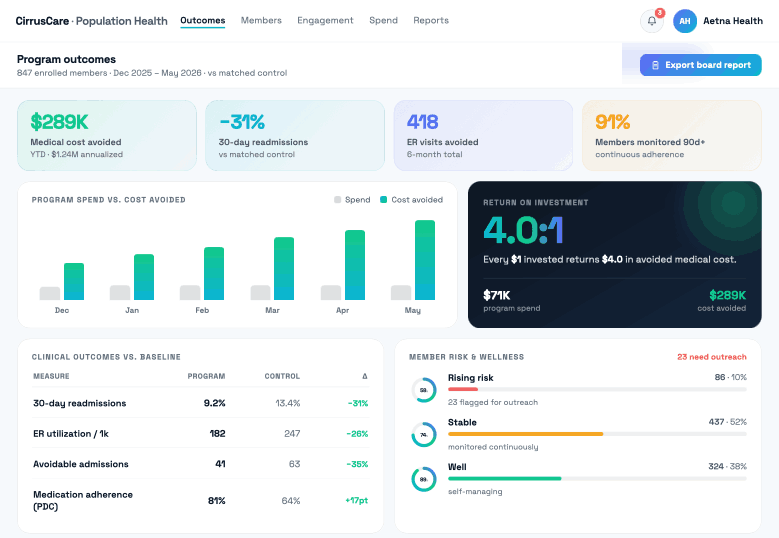
The population view surfaces drift while it is still a conversation, not an admission.
When two devices tell different stories, CirrusCare knows which to believe. Patent-pending.
Where risk is concentrating, and which members are drifting, weeks earlier than anything else shows it.
Blood pressure at 9:40 on a Tuesday, in a room they were nervous to be in. It lands inside the normal band, so nothing looks wrong. True, and almost never the whole story.
Nights, resting heart rate, glucose, movement, all read together against their own normal. The flags are the days that sat outside it, and what matters is that they kept coming, not that one of them happened.
“A measurement taken during a brief clinical encounter may tell us something important about a patient at that moment. A well-designed digital measure may help us understand how that patient is functioning across many moments — and whether a meaningful change persists over time.”U.S. FDA · Digital Health Center of Excellence, 2026
Care stops being a series of appointments and becomes something continuous that a wearer, a family, a clinician and a pharmacist all stand inside together.
You don't wear anything new and you don't log anything. The watch or ring you already own is enough. Nobody calls unless something has genuinely changed for you, so when they do, it's worth picking up.
You stop guessing from the sound of their voice. A calm signal that everything is as it should be, and one plain note when it isn't. That quiet is the part that lets you sleep.
Walk in already knowing how the last six weeks went, whether the change held, and which few people on the panel need you this morning. The visit stops being the first time you find out.
See whether the new dose actually landed in the days that followed, at home, in their real life. The counsel you give is the same; the evidence behind it isn't.
Nothing is shared without the person's documented consent. They can see who is looking, and stop it.
Every one of these gaps exists because nobody is watching between visits. Here is the gap on each side of it, and what closes it.
A fill record says the prescription was collected. It does not say they halved the dose because of dizziness, or stopped it after reading something online.
The review opens with what actually happened at home in the weeks after the fill. Same counsel, real evidence behind it.
Between appointments the panel goes dark. The next thing you hear is a symptom, a 5pm call, or a discharge summary, and by then you are reacting.
Nobody gets seen because the calendar said so. They get seen because something moved, and the weeks after discharge stop being a scramble.
You call to check. They say they're fine. You still don't know, so you carry it all week and drive over on Sunday to see for yourself.
A calm signal that everything is as it should be, and when something genuinely changes, plain language and a clinician who has already looked.
One continuous view, held by everyone who cares for the same person. That is what changes: care stops being something that happens at appointments and becomes something that is simply always there.
CirrusCare pays for itself in the work it makes possible, not in a new line item. Five things get better, and they are the same five things every partner has told us they care about.
Care management, principal and transitional care, and pharmacist medication review are established programs that fund attention between visits. That work exists today; what has been missing is the signal to do it well and the record to show it happened.
Risk-bearing employers and plans work with us per member, per month. Families can subscribe on their own.
Partners keep the value of care they are already accountable for, and pay us a platform fee. Nothing about CirrusCare depends on a new code or a new device.
Consumer wearable signal is clinical context, not a substitute for a clinical measurement. Every path runs through eligibility, documented consent and a real care plan. We say that first, in writing, before anyone asks.
No population thresholds. No noise at 3am. Just the moment a person drifts from what's normal for them.
The literature puts physiologic change 24–72 hours ahead of symptoms. That is the window your team gets back.
Heart and glucose signals read together tell a different story than either one alone, and the pharmacist sees it first.
Sleep and activity soften weeks before anyone calls the clinic. CirrusCare notices, and says so once.
Mechanism detail is available under NDA. What we will say publicly: it is patent-pending, and it does not work off a fixed number.
Every constraint in this product came from a clinician saying no to something.
Our design position · stated, not quoted
Two ways in. Tell us which one you are and we will set up the right first step, on the devices they already wear.
Stood up on the devices your patients already own. Nothing to ship, nothing to install at home.
Thank you. We will be in touch from support@cirrus-care.com.